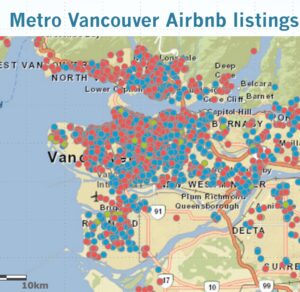
One of the most rewarding parts of doing a master’s degree in Urban Studies was the opportunity to carry out a significant piece of original empirical research, in the form of a thesis. After considering many housing-related topics, I settled on the idea of attempting to quantify the nature and extent of Airbnb listings in the City of Vancouver.
My other research goal was to analyze that data in relation to its impacts (or lack thereof) on the city’s ability to achieve its rental housing goals, in the context of a housing crisis that was both ongoing and acute. I thought this would be a useful contribution to policy debates given that at the time I started my research, neither the city nor the province had regulations that responded directly to the new realities of the so-called “sharing economy” or the then-emerging short-term rental phenomenon. Further, at the time, Airbnb’s website was set up to limit the total number of results returned from any given search to 300, which meant it was not possible to know the total number of Airbnb listings in the City of Vancouver (or any other large city). This was a barrier to understanding the full scope of Airbnb’s impacts.
I created a blog to chronicle my research and learning process. Then, through my academic contacts, I was fortunate to meet a local software programmer who was willing to write me a web-scraping script that circumvented Airbnb’s search limits. Once I had used this script to obtain my first batch of Airbnb listing data, I posted that data, along with my analysis of it (including caveats about its preliminary nature) on my blog and my Twitter feed. This ended up attracting considerable media attention, due to the fact that rental housing shortages and the high cost of housing were very much in the news at the time, and my web scraping enabled me to provide more complete information about the quantity and nature of Airbnb listings than the company had been willing to share with the public.
That 2015 blog post was the beginning of a three-year period in which I was frequently asked by local and national media outlets to comment on the subject of short-term rentals. At the same time, I was also fielding requests to speak to municipal staff about short-term rentals and to present at various conferences and meetings. This meant that through my research and public speaking, I was able to have far more impact on policy-making than is typical for a master’s student. Simon Fraser University and my own program recognized me for this, and for my academic record, by awarding me the Urban Studies Alumni Award for Community Engagement, among others.
You can read my entire thesis at this link: Short-term consequences: Investigating the extent, nature and rental housing implications of Airbnb listings in Vancouver. The abstract is below. I passed my thesis defence with no revisions, which was very unusual in my program.
Abstract